







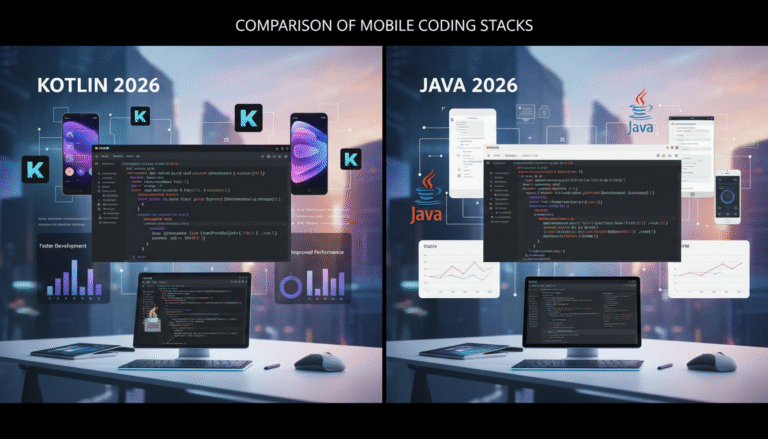
Choosing a solid career path in software engineering is vital to your future in India’s main tech hubs. As mobile systems change, the debate regarding kotlin vs java for android development remains a central concern to students. This helps you build better applications and secure great jobs in a competitive market.
Learning the current market helps you pick a tool that fits your specific goals. Many experts still use legacy systems while new creators often prefer clean and modern code. This choice impacts your speed and the quality of the products you create.
Strong engineering skills require staying ahead of these industry shifts. We will examine performance, style, and help from other coders to guide you. By the end, you will know which path gives the most value.
Picking well today ensures a great career in the mobile world.
1Key Takeaways
- Official guidance from major tech corporations on tool selection.
- Comparison of syntax brevity and maintenance ease.
- Career growth opportunities within the Indian IT sector.
- Impact on application stability and crash rates.
- Access to community libraries and technical support.
- Benefits of modern coding features over legacy options.
The Current State of Android Development Languages in 2026
In 2026, the choice between Kotlin and Java for Android development has become a critical decision for developers looking to stay relevant in the industry. The Android ecosystem continues to evolve, with both languages playing significant roles.
The landscape of Android development is influenced by various factors, including Google’s official stance on programming languages, industry adoption trends, and the implications of these factors for aspiring developers.
2Google's Official Language Stance
Google has officially endorsed Kotlin as the preferred language for Android development. This stance is reflected in the Android documentation and Android Studio, where Kotlin is the default language for new projects.
3Industry Adoption Trends
The industry’s adoption of Kotlin has been steadily increasing. Many companies are now using Kotlin for their Android projects due to its concise syntax and interoperability with Java.
- Kotlin’s concise syntax reduces boilerplate code.
- Interoperability with Java allows for mixed-language projects.
- Modern Android tools and libraries often prioritize Kotlin.
4What This Means for Aspiring Developers
For new developers, understanding both Kotlin and Java is beneficial. While Kotlin is the recommended language, knowledge of Java can be advantageous due to the existing codebase and legacy projects.
- Learning Kotlin can provide a competitive edge in the job market.
- Familiarity with Java can be useful for maintaining legacy projects.
- Understanding both languages can enhance career flexibility.
Understanding Java for Android Development
As we dive into the world of Android development, it’s essential to understand Java’s significant role.
Java has been a cornerstone of Android development since the operating system’s inception. Its influence on the Android ecosystem is profound, with a vast array of libraries, frameworks, and tools built around it.
5Java's Legacy in Android Ecosystem
🎓 Want to Master This Skill?
Join 10,000+ students at VFX India — Industry-standard training in Chennai with 100% placement.
🚀 Enroll Now💬 WhatsAppTwo Decades of Android Development
Java’s journey with Android began over two decades ago, and it has been instrumental in shaping the platform. The language has evolved significantly, adapting to the changing needs of developers and the ecosystem.
“Java is known for its platform independence, object-oriented design, and vast ecosystem, making it an ideal choice for large-scale Android applications.”
Mature Libraries and Frameworks
Over the years, Java has fostered a mature ecosystem of libraries and frameworks that simplify Android development. These tools have been refined through extensive use and community feedback.
6Current Java Versions and Android Compatibility
Java’s compatibility with the latest Android versions is crucial for developers. Android’s support for Java 8 and later versions has enabled developers to leverage modern language features.
The table below summarizes the compatibility of different Java versions with Android.
| Java Version | Android Compatibility | Key Features |
|---|---|---|
| Java 8 | Supported from Android 8.0 (API level 26) | Lambda expressions, method references |
| Java 9+ | Partially supported with desugaring | Modules, JShell |
| Java 11+ | Limited support with specific configurations | HTTP Client, var keyword |
The compatibility of Java with Android continues to evolve, with ongoing efforts to support newer Java versions.
In conclusion, Java remains a vital part of the Android ecosystem, with its legacy, mature libraries, and ongoing compatibility efforts making it a significant language for Android development.
Understanding Kotlin for Android Development
In the realm of Android development, Kotlin is gaining traction rapidly due to its modern features and Google’s backing. This section delves into Kotlin’s integration into Android development, focusing on its official adoption and the tools that make it a preferred choice.
7Kotlin's Official Adoption by Google
Kotlin’s journey to becoming a primary language for Android development began with Google’s official announcement.
The 2017 Announcement and Its Impact
In 2017, Google announced Kotlin as an officially supported language for Android development. This announcement had a significant impact on the developer community, as it brought a modern, concise, and safe language to the forefront.
“Kotlin is a modern programming language that makes developers happier. It’s concise, safe, interoperable with Java, and tool-friendly.”
— Google, 2017
The impact was immediate, with many developers beginning to explore Kotlin for their projects.
Kotlin-First Development Approach
Google’s Kotlin-First approach signifies that Kotlin is now the preferred language for Android development. This means that new APIs and features are often first introduced for Kotlin.
The Kotlin-First approach is more than just a preference; it represents a commitment to making Kotlin the go-to language for Android app development.
- Kotlin provides a more concise syntax, reducing boilerplate code.
- It offers better safety features, such as null safety, to prevent common programming errors.
- Kotlin is fully interoperable with Java, allowing for a smooth transition.
8Jetpack Compose and Modern Android Tools
Jetpack Compose is a modern UI toolkit that simplifies the development of user interfaces in Android apps. It is designed to work seamlessly with Kotlin.
Jetpack Compose allows developers to create UI components with less code and more intuitive APIs.
With Jetpack Compose, developers can take advantage of Kotlin’s concise syntax to build UI components.
Key Benefits of Jetpack Compose:
- Simplified UI development with less code.
- Improved performance and reduced runtime exceptions.
- Better integration with Kotlin, leveraging its language features.
Syntax and Code Readability Comparison
Syntax and code readability are crucial factors in deciding whether Java or Kotlin is more suitable for Android development projects. The way code is written and understood plays a significant role in the development process, affecting both the initial coding time and long-term maintenance.
9Verbosity in Java vs Conciseness in Kotlin
One of the most noticeable differences between Java and Kotlin is their level of verbosity. Java, being an older language, requires more lines of code to accomplish tasks that Kotlin can achieve with fewer lines.
Boilerplate Code Requirements
Java often necessitates boilerplate code, which can make development slower and maintenance more challenging. Kotlin, on the other hand, reduces the need for such repetitive code, enhancing developer productivity.
Real-World Code Examples
Consider a simple example of creating a data class in both languages. In Java, you would typically define a class with private fields, getters, setters, and possibly methods like toString() and equals(). In Kotlin, you can achieve the same with a single line of code using a data class.
// Kotlin data class example
data class User(val name: String, val age: Int)
versus
// Equivalent Java code
public class User { private String name; private int age; public User(String name, int age) { this.name = name; this.age = age; } // Getters, setters, toString, equals, etc.
}
10Type Inference and Variable Declarations
Kotlin’s type inference capability allows developers to declare variables without explicitly stating their type, making the code more concise. Java also has some level of type inference, particularly with the introduction of the var keyword in Java 10 and later.
For instance, in Kotlin, you can write:
val name = “John Doe” // Type inferred as String
While in Java, you would use:
var name = “John Doe”; // Type inferred as String in Java 10+
11Functional Programming Support
Both languages support functional programming concepts, but Kotlin has more extensive support through features like lambda expressions, higher-order functions, and function literals. This support makes Kotlin more adaptable to modern programming paradigms.
- Kotlin’s lambda expressions simplify event handling and data processing.
- Higher-order functions enable more flexible and reusable code.
In conclusion, Kotlin’s conciseness, type inference, and robust support for functional programming make it a more readable and maintainable choice for Android development compared to Java.
Performance and Compilation Speed
The debate between Java and Kotlin for Android development extends to their performance and compilation speed, crucial factors that can make or break an app’s success. Both languages have their strengths and weaknesses in these areas, impacting how efficiently an app runs and how quickly it can be developed and deployed.
12Runtime Performance Benchmarks
Runtime performance is a critical aspect of any Android application, directly affecting user experience. Both Java and Kotlin are compiled to bytecode that runs on the Dalvik Virtual Machine (DVM) or Android Runtime (ART), which means their runtime performance is closely related.
Execution Speed Comparison
Studies have shown that Kotlin and Java have similar execution speeds when compiled to bytecode. Kotlin’s concise syntax and additional features do not inherently slow down the execution. In some cases, Kotlin’s performance can be optimized further due to its language features that allow for more efficient coding practices.
Memory Consumption Analysis
Memory consumption is another vital metric. Kotlin’s coroutines, for instance, offer a more memory-efficient way of handling asynchronous programming compared to Java’s traditional thread-based approach. This can lead to better memory management in Kotlin, potentially reducing the risk of memory leaks.
13Compilation Time Differences
Compilation time is a significant factor during the development process. Kotlin is generally considered to have a slightly longer compilation time compared to Java, primarily due to its more complex compilation process that involves additional steps like desugaring and metadata processing. However, the overall impact on development speed is often mitigated by Kotlin’s concise syntax and the efficiency of modern build tools.
14APK Size and App Startup Time
The size of the APK and the app startup time are also important considerations. Kotlin’s standard library is relatively small and is often already included in many Android projects. Thus, the impact on APK size is minimal. Moreover, with proper optimization techniques, Kotlin apps can achieve similar startup times to their Java counterparts.
In conclusion, while both languages have their nuances in terms of performance and compilation speed, the differences are often minimal and can be mitigated through good coding practices and optimization. Developers should consider these factors alongside other language features when deciding between Java and Kotlin for their Android projects.
Null Safety and Error Handling
Null safety and error handling are crucial aspects of modern programming languages, significantly impacting the reliability and maintainability of Android applications. The way a language handles nullability can greatly affect the frequency of runtime errors and the overall stability of the app.
15The Billion Dollar Mistake in Java
Java’s history with null safety is marked by the infamous NullPointerException (NPE), often referred to as “The Billion Dollar Mistake.” This issue arises when an application attempts to use an object reference that has a null value.
NullPointerException Challenges
NPEs are a common source of frustration for developers, as they can occur unexpectedly and are often difficult to debug. The root cause typically lies in the lack of explicit null safety mechanisms in Java, making it challenging to prevent NPEs at compile time.
Optional and Annotation Approaches
To mitigate NPEs, Java developers have adopted various strategies, including the use of Optional classes and null annotations (@Nullable and @NonNull). While these approaches help, they are not foolproof and require meticulous coding practices to be effective.
16Kotlin's Built-in Null Safety System
Kotlin, on the other hand, boasts a built-in null safety system designed to eliminate the risk of NPEs. This system is based on the distinction between nullable and non-nullable types.
Nullable and Non-nullable Types
In Kotlin, references are non-nullable by default. To allow a reference to hold null, it must be explicitly declared as nullable by appending a ? to its type. This clear distinction helps developers avoid NPEs at compile time.
Safe Call and Elvis Operators
Kotlin further enhances null safety with operators like the safe call (?.) and the Elvis operator (?:). The safe call operator allows for safe navigation through potentially null references, while the Elvis operator provides a default value when a reference is null.

17Impact on Code Stability and Bug Reduction
Kotlin’s null safety features significantly reduce the likelihood of NPEs, leading to more stable code and fewer runtime errors. By catching potential null pointer exceptions at compile time, Kotlin helps developers write more robust and maintainable code.
The implications of Kotlin’s null safety system are profound, contributing to a reduction in bugs related to nullability and enhancing overall code quality. As Android development continues to evolve, the importance of such features cannot be overstated.
Modern Language Features and Functionality
In the realm of Android app development, the choice between Kotlin and Java hinges on their modern language features and functionality. Both languages have evolved significantly to support the demands of modern app development, including asynchronous programming, concise code syntax, and robust data handling.
18Asynchronous Programming Approaches
Asynchronous programming is crucial for developing responsive and efficient Android applications. Both Kotlin and Java offer distinct approaches to handling asynchronous operations.
Java Threading and ExecutorService
Java has traditionally relied on threading and ExecutorService for asynchronous programming. While effective, this approach can lead to complex code and potential concurrency issues if not managed carefully. Java’s threading model requires manual thread management, which can be error-prone.
Kotlin Coroutines and Flow
Kotlin, on the other hand, introduces a more streamlined approach to asynchronous programming with its coroutines and Flow API. Kotlin coroutines simplify asynchronous code, making it more readable and maintainable. The Flow API further enhances this by providing a reactive programming model that is both powerful and intuitive.
For instance, consider the following example of Kotlin coroutines:
import kotlinx.coroutines.* fun main() = runBlocking { launch { delay(1000L) println(“World!”) } println(“Hello,”)
}
This example demonstrates how coroutines can be used to delay the execution of a block of code without blocking the main thread.
19Extension Functions and Utility Methods
Kotlin’s extension functions allow developers to add functionality to existing classes without modifying their source code. This feature is particularly useful for creating utility methods that can be used throughout an application.
In contrast, Java does not natively support extension functions. However, similar functionality can be achieved through static utility methods, albeit with less elegance and flexibility.
20Data Classes vs Java POJOs
Kotlin’s data classes provide a concise way to create classes that mainly hold data. They automatically generate useful methods like equals(), hashCode(), and toString(), reducing boilerplate code.
Java, on the other hand, relies on Plain Old Java Objects (POJOs) for similar purposes. While POJOs are straightforward, they require manual implementation of these utility methods, leading to more verbose code.
21Smart Casts and Type Checking
Kotlin’s type system is designed to eliminate the danger of null references and provide more robust type checking. Smart casts in Kotlin automatically cast objects to their target type after a successful type check, reducing the need for explicit casting.
Java also supports type checking but lacks the smart cast feature. This means Java developers must explicitly cast objects, potentially leading to ClassCastException at runtime if not handled carefully.
Learning Curve and Developer Experience
The choice between Kotlin and Java for Android development in 2026 hinges not just on their technical capabilities, but also on the learning curve and overall developer experience.
22Time Required for Beginners to Become Productive
Beginners often wonder how long it takes to become proficient in either language. The journey to productivity varies based on prior experience and the learning path chosen.
Java Learning Path
For Java, the learning path typically involves understanding object-oriented programming concepts, familiarizing oneself with the Java Development Kit (JDK), and learning Android-specific Java APIs.
- Foundational Knowledge: 1-3 months
- Android Development Basics: 3-6 months
- Advanced Topics and Projects: 6-12 months
Kotlin Learning Path
Kotlin, being more concise and with modern language features, can potentially have a shorter learning curve.
- Foundational Knowledge: 1-2 months
- Android Development with Kotlin: 2-4 months
- Mastering Kotlin Coroutines and Advanced Features: 4-8 months
23Transitioning Between Languages
For developers already familiar with one language, transitioning to the other is relatively straightforward due to their interoperability.
24Quality of Documentation and Tutorials
Both languages have extensive resources available.
Official Documentation
Java Documentation is comprehensive but can be overwhelming for beginners. In contrast, Kotlin Documentation is known for its clarity and conciseness, with extensive examples.
Community-Created Resources
Platforms like Udacity, Coursera, and YouTube have numerous courses. Additionally, forums like Stack Overflow and personal blogs offer insights and solutions to common problems.
Job Market and Career Opportunities in India
The Indian tech industry is witnessing a significant surge in demand for Android developers, driven by the country’s growing smartphone market. As the digital landscape expands, career opportunities in Android development are becoming more diverse and lucrative.
25Android Developer Demand in Indian Tech Hubs
Major tech hubs in India, such as Bangalore, Pune, and Hyderabad, are experiencing a high demand for skilled Android developers. These cities are home to numerous tech companies, startups, and innovation centers, creating a fertile ground for career growth.
Bangalore, Pune, and Hyderabad Markets
Bangalore, known as the Silicon Valley of India, is a major hub for tech companies and startups. Pune and Hyderabad are also emerging as significant centers for Android development, with many companies setting up their development centers there.
Remote Opportunities for Indian Developers
The shift towards remote work has opened up new avenues for Indian Android developers. Many global companies are now hiring Indian talent for remote positions, providing flexibility and access to a global job market.
26Java Developer Positions in 2026
Java remains a widely used language in Android development, and the demand for Java developers continues to be strong. Many legacy applications are still maintained and updated using Java, ensuring a steady demand for skilled Java developers.
27Kotlin Developer Positions in 2026
Kotlin, being the officially supported language for Android development by Google, is gaining popularity rapidly. The demand for Kotlin developers is on the rise, driven by new projects and the migration of existing applications to Kotlin.
28Salary Comparisons and Growth Potential
Both Java and Kotlin developers have lucrative career prospects in India. The salaries for these positions are competitive, with Kotlin developers sometimes commanding a premium due to their expertise in the officially supported language.
| Developer Type | Average Salary (INR) | Growth Potential |
|---|---|---|
| Java Developer | 600,000 – 1,200,000 | Moderate |
| Kotlin Developer | 800,000 – 1,500,000 | High |
| Android Developer (Java/Kotlin) | 700,000 – 1,400,000 | High |

Kotlin Vs Java For Android Development 2026: Direct Comparison
As Android development advances into 2026, understanding the direct comparison between Kotlin and Java is essential for making informed decisions about which language to adopt. This comparison will cover critical aspects such as interoperability, community size, IDE support, and long-term maintenance considerations.
29Interoperability and Mixed Codebases
One of the significant advantages of both Kotlin and Java is their interoperability. This feature allows developers to integrate both languages into a single project seamlessly.
Calling Java from Kotlin
Kotlin is designed to be fully interoperable with Java, making it straightforward to call Java code from Kotlin. This interoperability is crucial for projects that wish to leverage the strengths of both languages.
Example: In Kotlin, you can directly import and use Java classes without any additional setup.
Calling Kotlin from Java
Similarly, Kotlin code can be called from Java, although it might require some additional considerations, such as handling Kotlin’s language features that don’t have direct Java equivalents.
For instance, when calling Kotlin functions from Java, you might need to handle Kotlin’s default arguments and named parameters appropriately.
30Community Size and Third-Party Libraries
The size of the community and the availability of third-party libraries are crucial factors when choosing a programming language.
Java has a vast and established community, with a wide range of libraries available. Kotlin, while newer, has been rapidly gaining popularity and has a growing ecosystem of libraries and tools.
31IDE and Tooling Support
Both Kotlin and Java have excellent support in Android Studio, the official IDE for Android development.
Android Studio Integration
Android Studio offers comprehensive support for both languages, including code completion, debugging, and project setup wizards.
Debugging and Profiling Tools
The IDE provides robust debugging and profiling tools for both Kotlin and Java, helping developers optimize their applications.
32Long-term Maintenance and Support
When choosing a language, it’s essential to consider the long-term maintenance and support implications.
Java has a long history and is well-established, with continued support from Oracle and the open-source community. Kotlin, being a more modern language, is also well-supported by JetBrains and Google.
33Migration Considerations for Existing Projects
For existing projects, the decision to migrate from one language to another involves careful consideration of the costs and benefits.
Projects written in Java can gradually incorporate Kotlin, thanks to their interoperability. However, a thorough assessment of the project’s requirements and the potential impact on development time and resources is necessary.
Which Language Should You Choose in 2026
The decision between Kotlin and Java for Android development in 2026 hinges on several factors, including your career goals and project requirements. As the Android ecosystem continues to evolve, understanding the strengths of each language is crucial for making an informed decision.
34Best Choice for Complete Beginners
For complete beginners, Kotlin is often recommended as the first language to learn for Android development. Kotlin’s concise syntax and modern language features make it easier to learn and more enjoyable to code with. Additionally, Google’s official support for Kotlin as a primary language for Android development means there are extensive resources available for learning.
Beginners can benefit from Kotlin’s:
- Simplified syntax that reduces boilerplate code
- Null safety features that prevent common programming errors
- Interoperability with Java, allowing for a gradual learning curve
35Recommendations for Java Developers Looking to Expand
For Java developers, learning Kotlin can be a strategic move to expand their skillset. Kotlin’s interoperability with Java means that developers can easily integrate Kotlin into their existing Java projects. This allows Java developers to leverage Kotlin’s modern features without abandoning their existing codebase.
Java developers can benefit from learning Kotlin by:
- Enhancing their productivity with Kotlin’s concise syntax
- Utilizing Kotlin’s advanced features for new projects or modules
- Improving their overall Android development skills
36Advice for Career Switchers Entering Android Development
Career switchers entering Android development should consider their background and experience. If they have a background in Java or a related programming language, transitioning to Kotlin can be relatively straightforward. For those without prior programming experience, starting with Kotlin is advisable due to its modern design and the extensive support provided by Google and the developer community.
37The Hybrid Approach: Learning Both Languages
Adopting a hybrid approach by learning both Kotlin and Java can be highly beneficial. This approach allows developers to understand the strengths and weaknesses of each language and make informed decisions based on project requirements. Moreover, being proficient in both languages enhances a developer’s versatility and marketability in the job market.
By understanding the nuances of both Kotlin and Java, developers can:
- Work on a wider range of projects, including legacy Java projects and modern Kotlin-based applications
- Collaborate more effectively with teams using different languages
- Make more informed decisions about which language to use for specific projects
Conclusion
As we look to the future of Android development in 2026, the choice between Kotlin and Java remains a crucial decision for developers. Throughout this article, we’ve explored the strengths and weaknesses of both languages, from syntax and performance to null safety and job market trends.
The kotlin vs java conclusion is not a straightforward one, as both languages have their place in the Android ecosystem. Kotlin’s modern design and official support from Google make it an attractive choice for new projects, while Java’s legacy and compatibility ensure it remains a viable option for existing applications.
Ultimately, the future of android development future will likely involve a combination of both languages. As the Android landscape continues to evolve, developers who are proficient in both Kotlin and Java will be well-positioned to adapt to changing demands and capitalize on emerging opportunities.
By understanding the unique strengths of each language, developers can make informed decisions about their career paths and project choices, setting themselves up for success in the ever-changing world of Android development.

Master VFX, Design & AI in Chennai
Industry-standard training with 100% job placement. Start your creative career today!
🚀 Enroll Now💬 WhatsApp Us📂 Categories
Graphic Design (49)VFX (21)Action CGI (11)Visual Effects (10)Live Action (9)Typography (9)chroma key (6)Green Screen Keying (6)Stereoscopic 3D (5)Digital Marketing (5)Visual Effects (5)SEO (5)Camera Tracking (4)3D Movie (3)AI Graphic Design (2)app Development (2)UI UX (2)Match moving (1)Web Development (1)Film Editing (1)🎯 Related Courses
📚Graphic Design Course in Chennai📚VFX Course in Chennai📚Video Editing Course in Chennai📰 Recent Posts